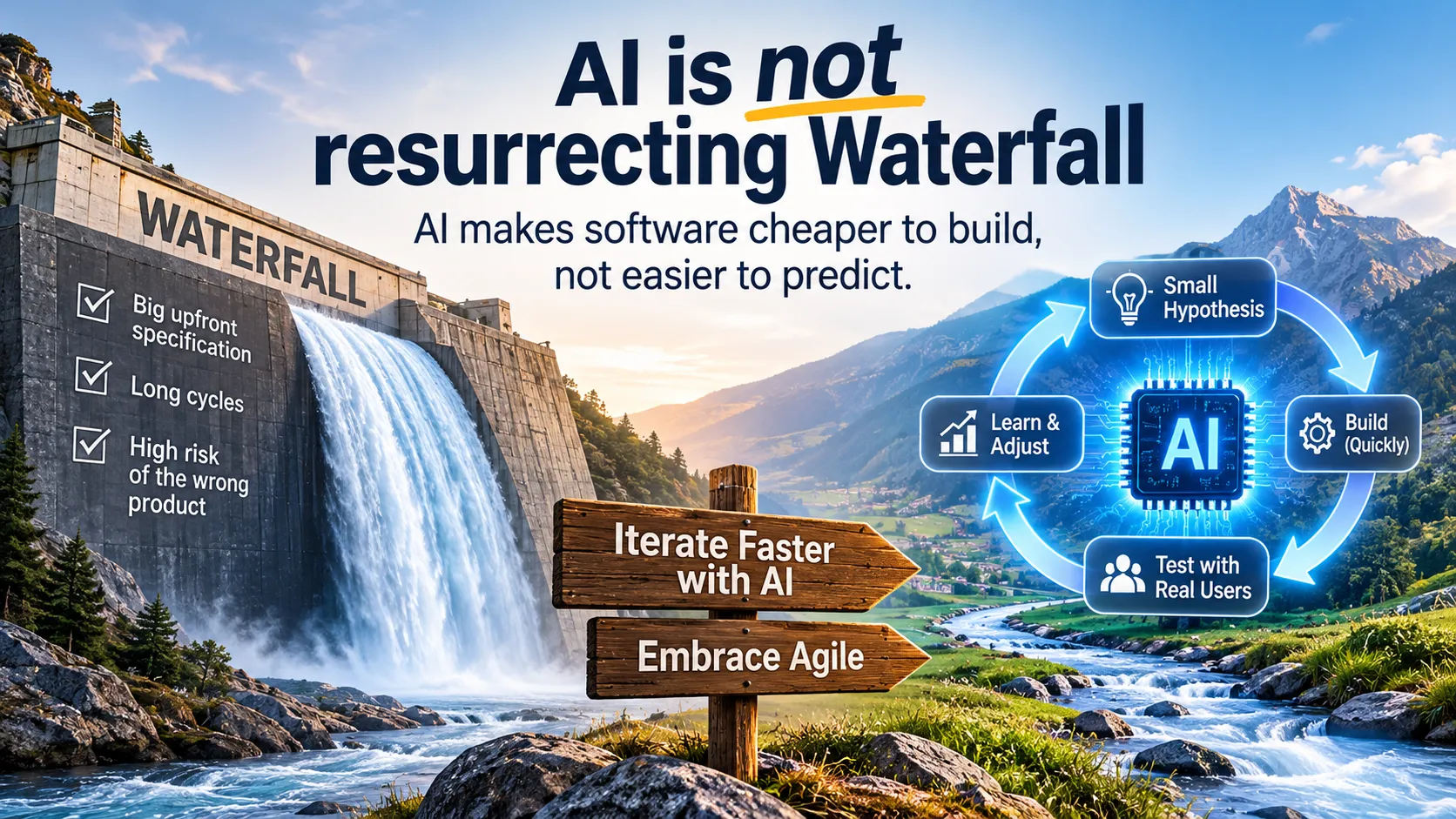
In recent months I keep running into articles by developers and tech leaders who make a curious claim: AI-assisted development is bringing the Waterfall methodology back into fashion at the expense of agile methods.
At first glance the reasoning seems to hold up. To get good code from an LLM, vague instructions are not enough. You need very detailed specifications, clearly defined constraints and as much context as possible provided upfront. Ergo, we are going back to upfront design.
Yet this deduction is deeply wrong. It assumes a poor historical memory of the reasons that led the industry to abandon Waterfall, and it betrays a superficial understanding of agile methods and of the reason they exist.
The core misunderstanding: the “How” versus the “What”
Whoever sees a return to Waterfall confuses the size of the batch of work with the rigor of the specification.
The misunderstanding comes from an old cliché: the idea that “Agile” means working without documentation, navigating by sight and throwing code together without much thought. In reality, anyone who has seriously practiced agile approaches, from Extreme Programming (XP) to Behavior-Driven Development (BDD), knows that writing clear, rigorous, unambiguous acceptance criteria before implementing a feature has always been a fundamental good practice.
Today there is a lot of talk about spec-driven development with LLMs, but writing an executable specification or an acceptance test before the code is exactly what Agile has been doing for twenty-five years. The difference between Waterfall and Agile lies in what you try to predict and when you do it:
- Waterfall claims to define in advance, with an exhaustive level of detail, the entire scope of a complex product before a single line of code has been written.
- Agile acknowledges an uncomfortable but unavoidable truth: it is impossible to clearly define all the features of a complex software product before having tried it and received real feedback from users.
Waterfall failed because uncertainty lives in the problem domain, in the changing needs of people and in market dynamics. Writing a perfect prompt does not make the behavior of end users any more predictable.
The real revolution of LLMs: near-zero-cost iterations
If we look at the development process as a whole, a mature use of LLMs takes us away from the Nineties: it pushes the iterative and incremental cycle to its extreme.
The main bottleneck of traditional agile processes has always been the cost, in time and resources, of turning a hypothesis into working software to put in front of the user. It often took weeks to build an increment sufficient to validate an idea, with the result that teams grew too attached to the code they had written and became reluctant to throw it away when the market showed the assumption was wrong.
Today AI radically lowers this cost of realization, taking core XP principles such as frequent releases and simple design to the limit:
- Take a single, small product hypothesis.
- Write a surgical specification for that micro-increment (exactly as you would in BDD).
- Generate a working prototype in a few hours, put it in front of a real user, find out that the initial idea does not work, and start over the next day without guilt.
This is the essence of the Build-Measure-Learn cycle taken to its maximum speed.
The risk of the “new Waterfall”
There is, however, a concrete danger for those who fall for the illusion that AI makes the iterative approach superfluous.
Since it is now very easy to generate thousands of lines of working code from a long requirements document written at a desk, whoever adopts a Waterfall mindset risks simply producing the wrong software at a much higher speed. Instead of taking months to discover that we built a product nobody wants, we can now get there in a few weeks, accumulating along the way a mountain of code and technical debt that nobody has fully read or understood.
Software development remains a process of continuous discovery and learning. Artificial intelligence changes the economics of error: getting things wrong costs far less, and correcting course is infinitely faster. Giving up iteration just now, when we have the tools to do it at the speed of light, would be the greatest paradox of our industry.